Home » Oranje Blog » Holland Qualifies for the World Cup — But the Road Was Far From Convincing
Holland Qualifies for the World Cup — But the Road Was Far From Convincing
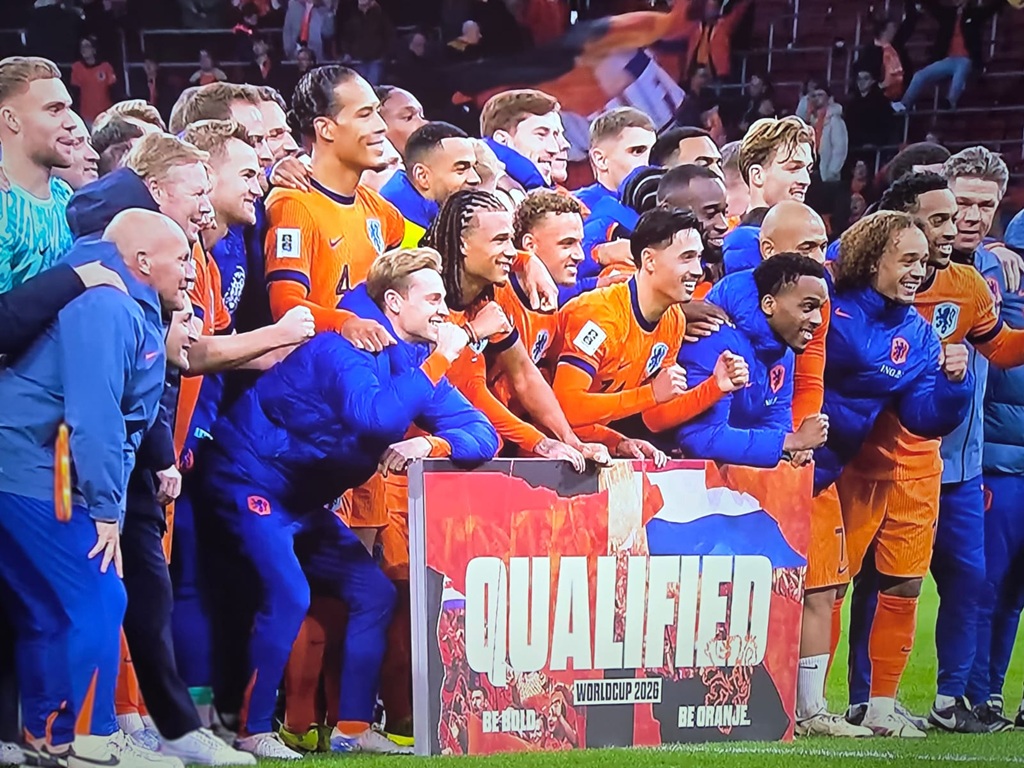
A 4–0 win over Lithuania is, on paper, the kind of straightforward result that suggests smooth qualification. But anyone who followed Holland’s campaign closely knows that this World Cup ticket was anything but effortless. In what was objectively a weak group, Oranje managed to secure qualification early—already in June, after an 8–0 demolition of Malta combined with Poland’s unexpected defeat to Finland—but the performances themselves revealed deeper structural concerns.
For a nation with Holland’s footballing pedigree, the expectation was not merely to qualify, but to dominate this group with authority. Instead, the campaign exposed not only inconsistencies but also a worrying lack of control in matches that should have been routine.
Poland: The Only Real Test We Failed—Twice
The most telling detail of the entire qualification run lies in the two matches against Poland—the only opponent in the group with comparable quality. Holland failed to beat them twice, drawing 1–1 both at home and away.
If Holland wants to be seen as a contender again, they need to beat teams like Poland consistently. These draws were not just dropped points; they were a reflection of broader issues: slow starts, sloppy transitions, and moments of inattention at the worst possible times.
The goal conceded away to Poland—five Dutch defenders facing only two Polish attackers and still being breached—perfectly symbolized the concentration lapses that plagued this campaign.
The Lithuania Reminder: Talent Without Consistency
Perhaps the most shocking warning sign came in Lithuania, where Holland inexplicably needed five defenders just to secure a shaky 3–2 win—this after leading 2–0 in what should have been a straightforward night. This is the same Holland that earlier in the year impressed with two excellent matches against Spain. The contrast could not be more dramatic.
How can a side that competes with Europe’s strongest teams collapse under modest pressure from Lithuania? The answer seems to lie not in talent, but in mentality: inconsistency, complacency, and a lack of sustained focus.
If Holland wants to survive beyond the early rounds of the World Cup, these issues simply cannot continue.
Injuries, Depth, and the Persistent Striker Problem
The positive news is that the Dutch squad is full of talent—arguably more than in previous cycles—especially when everyone is fit. But the injury risk is always looming. The squad’s overall strength depends heavily on key players staying healthy throughout the year.
One position remains a clear weakness: the striker role. This has been a recurring issue for more than a decade, and qualification did little to solve it. Despite this, there is hope. Rising talents like Emegha, who impressed with his dynamism and energy, and promising forwards such as Meerdink could provide much-needed freshness. If older, experienced players also regain fitness, Holland might just assemble a competent attacking line in time for the tournament.
But hope alone won’t score goals at a World Cup. Someone needs to establish themselves as the reliable finisher—something qualification did not deliver.
Progress or Stagnation? A Mixed Answer
There is legitimate progress. Today’s match alone featured nine Premier League players in the starting lineup—quality and experience that many national teams can only dream of. On an individual level, many Dutch players have grown remarkably in their club environments.
But did they truly deliver as a collective during qualification?
The honest answer is: yes, they delivered results—but no, they did not shine.
Compared to the European Championship semifinal run against Germany, Ronald Koeman used 7–8 of the same players throughout qualification. You would expect continuity to create stability, confidence, and improved chemistry. Instead, the team struggled to impose itself on sides that defended deep and countered quickly. Breaking down compact, defensive-minded opponents remains a persistent weakness.
With the talent available, Holland should not be relying on late surges, tactical adjustments, or moments of brilliance to beat Lithuania or Malta. They should be controlling games from start to finish.
Stability Must Become the Foundation
If there is one theme that defines this entire qualification, it’s the lack of stability. Too often, the team played in bursts—20 minutes of dominance followed by 15 minutes of chaos. The energy levels varied wildly from match to match. Concentration came and went.
And while individual mistakes are part of football, systemic fragility is not acceptable for a team with Holland’s ambitions.
The World Cup will punish inconsistency far more severely than this group did. To make a real impact, Oranje must bring:
Higher concentration (no more giving away goals in situations of numerical superiority)
Greater intensity (players like Enegma show what fresh energy can add)
Clearer tactical identity against deep-defending teams
Reliable finishing from whoever claims the striker role
If these pieces fall into place, Holland can be dangerous. If not, an early exit seems likely.
Looking Ahead—Friendly Tests and Talents
March 2026 will bring two valuable home friendlies: one against a South American opponent and one likely from Europe. These matches will be crucial. Expect Koeman to give young talents more opportunities, especially those pushing for a breakthrough before the World Cup squad is finalized. It will also be an important moment to test tactical variations and lineup stability.
The next generation is promising—but it needs meaningful minutes, not theoretical potential.
How Does This Team Compare to the 2010 Generation?
A natural question emerges: Is this the best team we’ve had since 2010?
The short answer: no, the 2010 team was better.
That squad had world-class players in peak form—Sneijder, Robben, Van Persie, Van Bommel, Kuyt, and a defensively solid unit led by Heitinga and Mathijsen. More importantly, they had an elite mentality: ruthless, disciplined, and mentally unshakeable. They could grind out results against any opponent, strong or weak.
This current team has more players in top European leagues, but lacks the collective cohesion and consistency of 2010. The talent is there—perhaps even more broadly distributed—but elite mentality is still missing.
Conclusion: Qualified, Yes—Convinced, Not Quite
Holland’s qualification is deserved, but not reassuring. The team showed glimpses of brilliance alongside worrying lapses. The results were enough to reach the World Cup, but the performances left many questions unanswered.
If Oranje wants to achieve something meaningful next summer, the inconsistency, the lack of stability, and the concentration issues must be addressed immediately. The talent is absolutely there—but talent without focus will not survive the World Cup.
The draw next month will tell us what awaits Holland. But regardless of the opponents, one truth is clear:
If Holland wants to compete with the world’s best, they must first learn to dominate the games they are expected to win.
Latest Comments
As a left winger Lang terrorized Liverpool yesterday..konate looked like clown infront him. Summerville is doing that in week by…
When koeman is going to name the squad for March two games?
Today slot was forced to try Ngumoha at left and Gakpo at center.Which worked,Ngumoha terrorised wolves from left his involvement…
Gakpo and Slot had another poor game and lost...Slot has lots of flaws as coach...the new sigings of pool Writz…
i hope de jong stays out of games till may 1st week or late...We will get a fresh Frenkie..
We have no business at world cup with koeman…He is a serial looser…
here i will put the results again copy paste
Koeman Beat absolute minnows like Malta, Lithuania and Finland and struggles against average teams like Poland, Austria, Bosnia & herzengovina, Hungary Etc…. In fact, Since Koeman took over from Van Gaal Netherlands have been beaten by every single team considered their equal or above them. They have also drawn or beaten by teams said to be average but solid teams. \
Here is the compilation of Netherlands games since Koeman took over the team.
Against Bigger teams
FRANCE 4 NETHERLANDS 0
CROATIA 4 NETHERLANDS 2
ITALY 3 NETHERLANDS 2
FRANCE 2 NETHERLANDS 1
GERMANY 2 NETHERLANDS 1
FRANCE 0 NETHERLANDS 0
AUSTRIA 3 NETHER;LANDS 2
ENGLAND 2 NETHERLANDS 1
GERMANY 2 NETHERLANDS 2
GERMANY 1 NETHERLANDS 0
SPAIN 2 NETHERLANDS 2
SPAIN 3 NETHERLANDS 3
Austria 3 Netherlands 2
Turkiye 0 netherlands 1 (Netherlands Escapes against Red Carded Turkiye)
Hungary 1 Netherlands 1
Bosnia and Herzengovina 1 Netherlands 1
Poland 1 Netherlands 1
Poland 1 Netherlands 1
Also to conclude, if there was one game there was worthy of being praiseworthy then it was the games against Spain. In both those games The Dutch played commendably well.







Koeman will spoil this generation,he is slow and dimwit…
Pot 2-3 can be tricky for any team resulting in pool of death.
Nerthlands, croatia, Norway, Ghana.
Nerthlands, *Italy, Scotland, Saudi
Easiest being Netherlands,Iran, Tunisia and any team from pot 4. But most likely will go to Argentina.
Pot 2-3 like I said will be tricky. Solid teams in there.
https://m.facebook.com/groups/364638057688456/permalink/2042911433194435/?mibextid=wwXIfr
I don’t think we can get Iran and Tunesia in one group? Or maybe we can. Norway will be a tough nut to crack. Italy is doable.
Japan is no joke, either.
Gefeliciteerd Nicolaas!
Indeed!
We have no business at world cup with koeman…He is a serial looser…
here i will put the results again copy paste
Koeman Beat absolute minnows like Malta, Lithuania and Finland and struggles against average teams like Poland, Austria, Bosnia & herzengovina, Hungary Etc…. In fact, Since Koeman took over from Van Gaal Netherlands have been beaten by every single team considered their equal or above them. They have also drawn or beaten by teams said to be average but solid teams. \
Here is the compilation of Netherlands games since Koeman took over the team.
Against Bigger teams
FRANCE 4 NETHERLANDS 0
CROATIA 4 NETHERLANDS 2
ITALY 3 NETHERLANDS 2
FRANCE 2 NETHERLANDS 1
GERMANY 2 NETHERLANDS 1
FRANCE 0 NETHERLANDS 0
AUSTRIA 3 NETHER;LANDS 2
ENGLAND 2 NETHERLANDS 1
GERMANY 2 NETHERLANDS 2
GERMANY 1 NETHERLANDS 0
SPAIN 2 NETHERLANDS 2
SPAIN 3 NETHERLANDS 3
And Whom did they beat??? here is the List
Gibraltar 0 Netherlands 3
Greece 0 Netherlands 3
Ireland 1 Netherlands 2
Greece 0 Netherlands 1
Ireland 0 Netherlands 1
Gibraltar 0 Netherlands 6
Scotland 0 Netherlands 4
Iceland 0 Netherlands 4
Poland 1 Netherlands 2
Romania 0 Netherlands 3
Turkiye 1 Netherlands 2
Bosnia Herzengovina 2 Netherlands 5
Hungary 0 Netherlands 4
Finland 0 Netherlands 2
Malta 0 Netherlands 8
Lithuania 2 Netherlands 3
Lithuania 0 Netherlands 4
Against Solid Average teams
Austria 3 Netherlands 2
Turkiye 0 netherlands 1 (Netherlands Escapes against Red Carded Turkiye)
Hungary 1 Netherlands 1
Bosnia and Herzengovina 1 Netherlands 1
Poland 1 Netherlands 1
Poland 1 Netherlands 1
Also to conclude, if there was one game there was worthy of being praiseworthy then it was the games against Spain. In both those games The Dutch played commendably well.